
Download full report here.
5th International Meeting of the Network of Social Clinics
Hamburg, 4–7 June 2026
REPORT
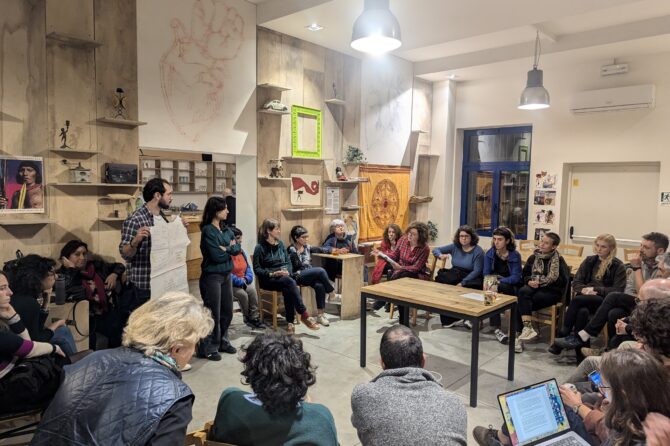
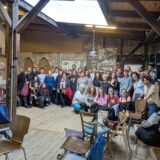
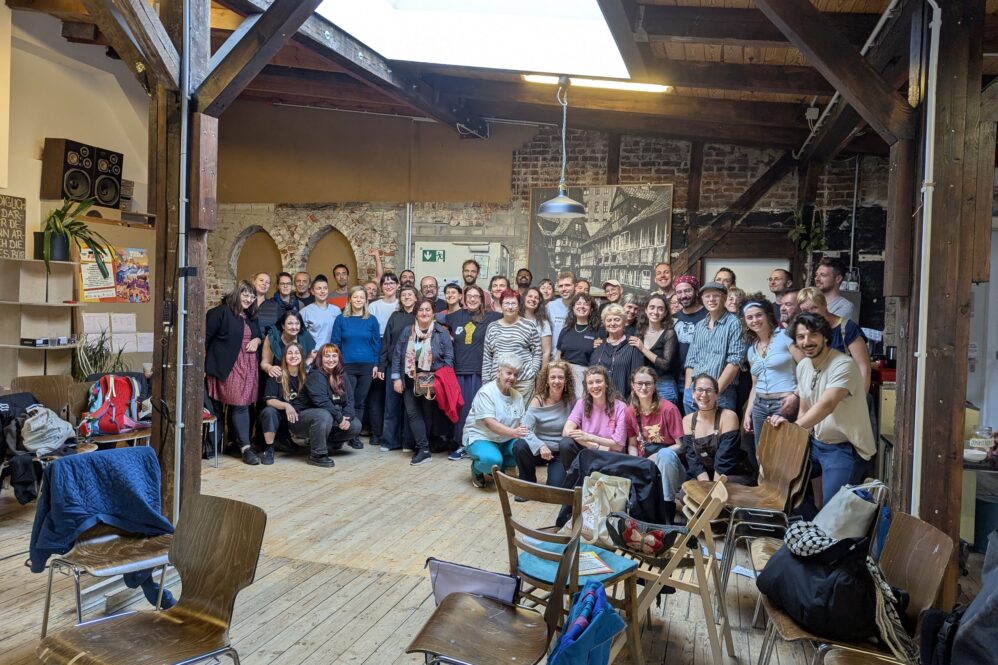
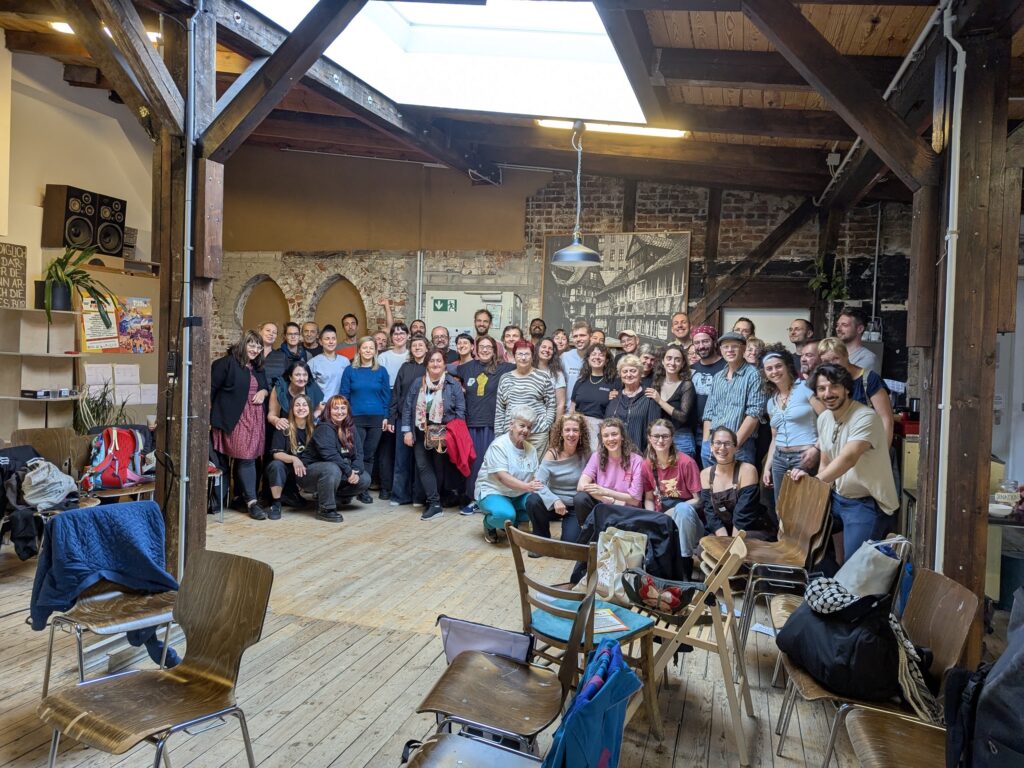
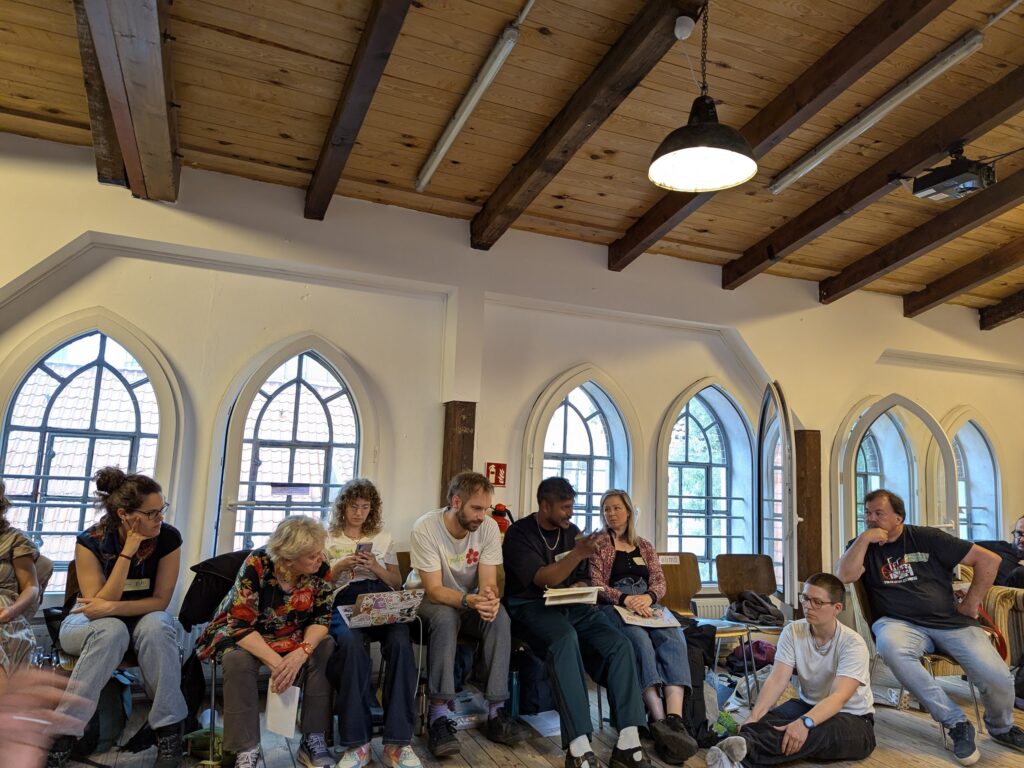
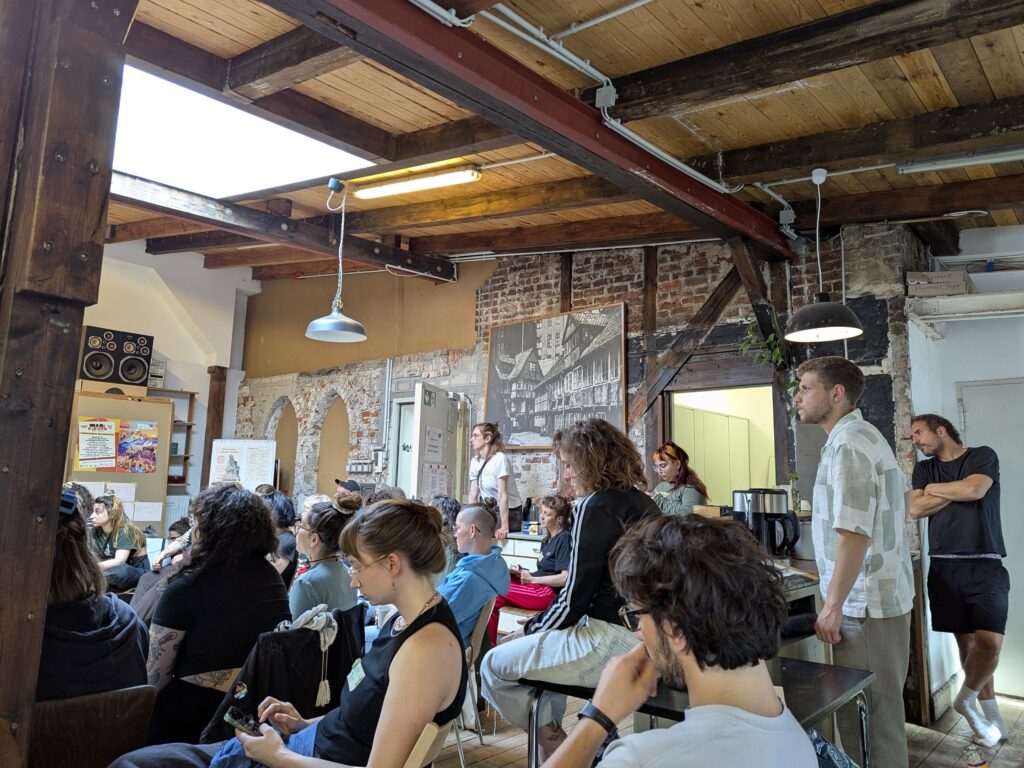
From 4 to 7 June 2026, almost a hundred of us gathered in Hamburg for the fifth international meeting of our network — comrades from social clinics, solidarity health centres and collectives across Greece, Germany, Italy, Belgium and the United Kingdom. We came together at a moment when the crises of capital have become planetary — war, militarisation, the dismantling of public health, the hardening of borders — to share our everyday practices, argue through our disagreements, and strengthen the transnational solidarity that holds us together. We were joined by new clinics and new collectives looking to join the network, a sign that the movement continues to grow even as the conditions around us worsen.
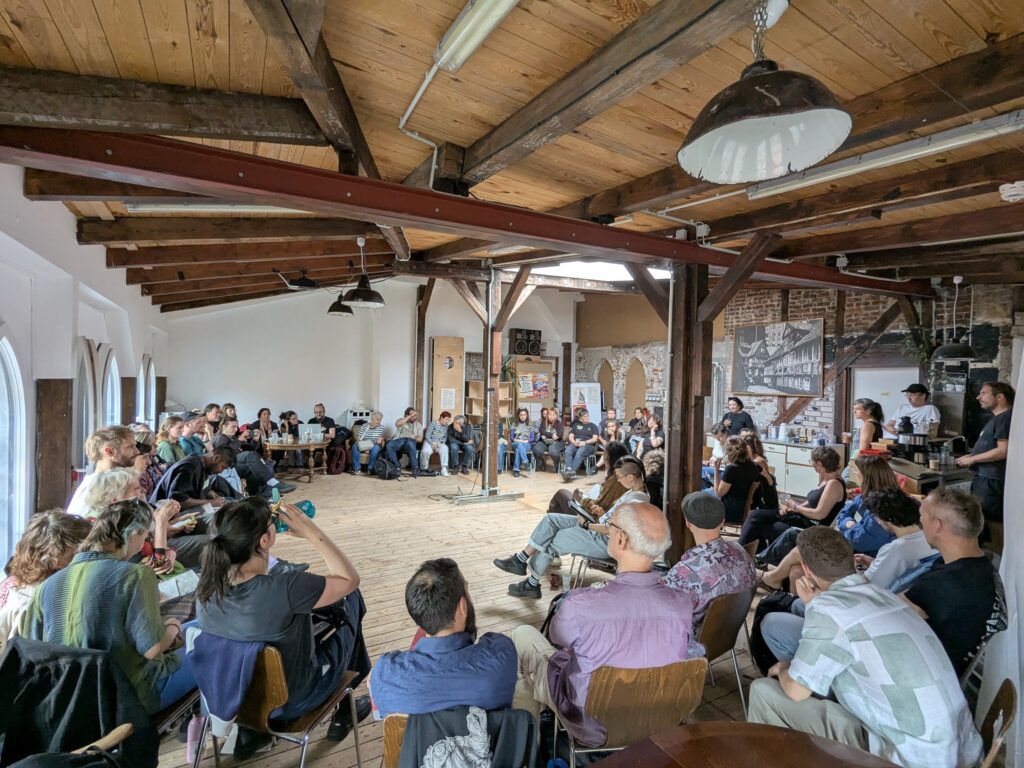
Our days together were structured around inputs and long collective discussions: on the everyday practices, cultural conflicts and internal tensions of our clinics; on dehumanisation, with an input from KIA (Thessaloniki); on the militarisation of healthcare, with an input from the German Democratic Doctors (VDÄÄ); on a manifesto for psychosocial support in times of collapse, presented by Medico International; and on mutualism and financing, with an input from Medicine Pour le Peuple (Belgium). Running through everything was an urgent solidarity intervention from the Community of Squatted Prosfygika in Athens, joining us live from the squat, and the active participation in Hamburg’s demonstration against the cuts in social welfare spending.
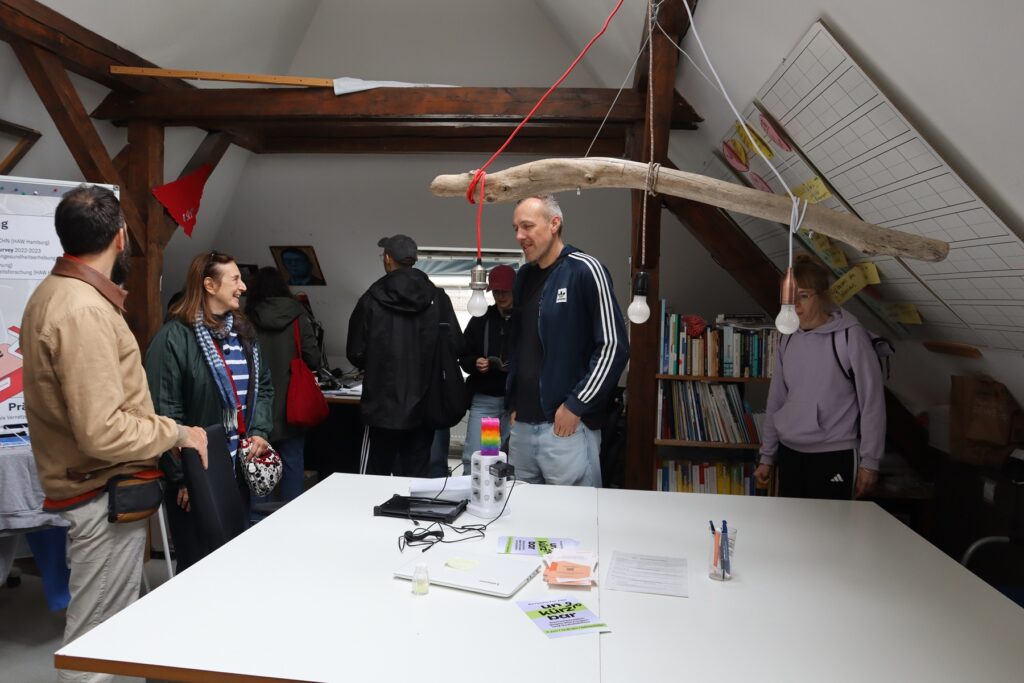
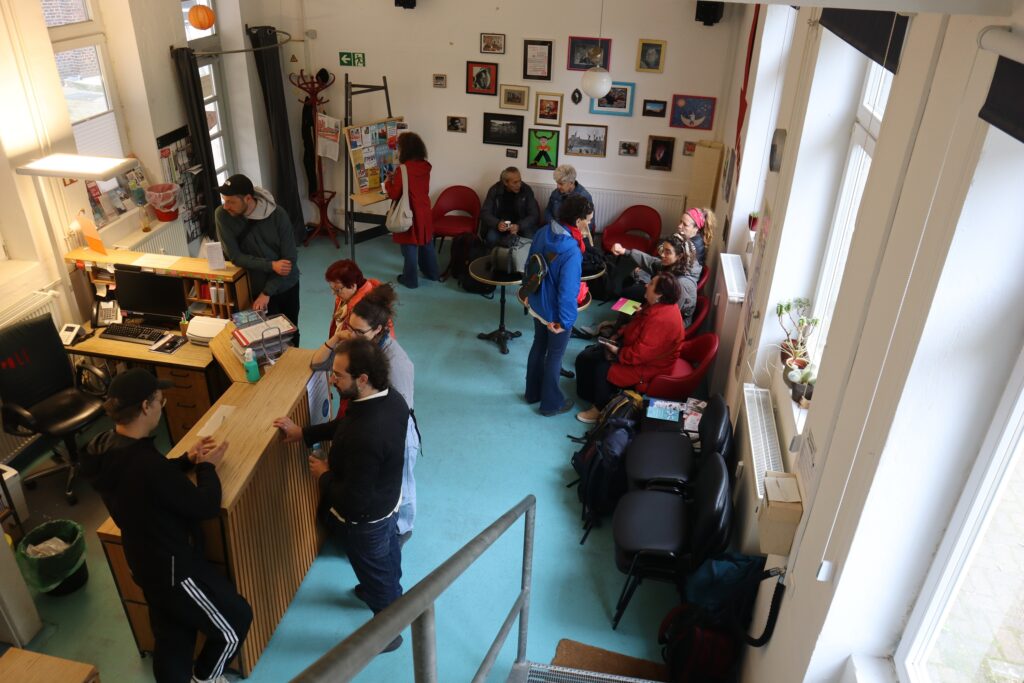
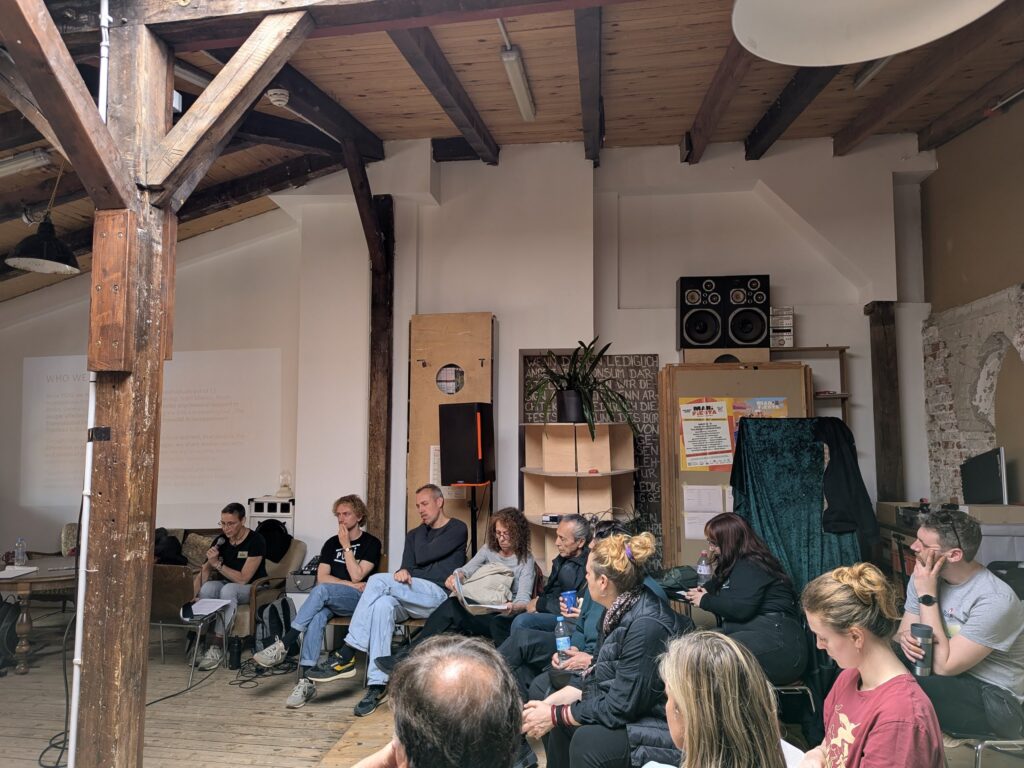
We met in the Gängeviertel — a cluster of historic houses in central Hamburg saved from demolition and speculation by a 2009 artists’ and activists’ occupation, and held ever since as a self-organised space for culture and political life. It was a fitting home for a network like ours. None of it would have been possible without the extraordinary work of the organising comrades from the Poliklinik Veddel, and of the collective who fed us — generously and deliciously — across the three days. Solidarity is also made of meals cooked and shared.
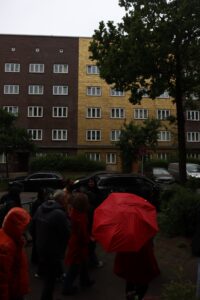
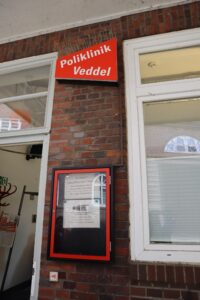
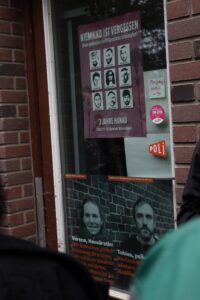
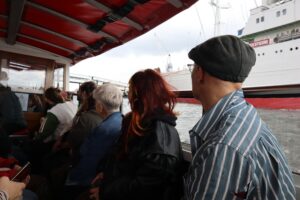
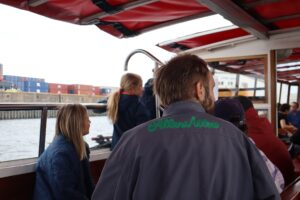
On the Sunday we took to the neighbourhood and the water. The morning was a tour of the Veddel, the working-class, migrant district on an island in the harbour that is home to the Poliklinik — a place long shaped by industry, migration and marginalisation. The afternoon was a tour of the port of Hamburg organised around the theme of health. Comrades from the Poliklinic Veddel and two historians guided us through the cholera epidemics that marked the city’s history, the devastating impacts of the supply chain of meat and soy, how cruise ships and gentrification have impacted on sex work, labour and the working conditions of who is on the ships, and the global trade routes and multinationals that run through the harbour. Through the canals, moving between different times and geographies we were able to see the circuits of imperialism and capital that determine, far upstream, who stays healthy and who does not.
What follows is our collective record of the meeting, session by session.
FRIDAY MORNING
Everyday Practices, Cultural Conflicts and Internal Tensions
The meeting opened with parallel working groups on the everyday life of our clinics: what we find inspiring in each other’s work, where we get stuck, and the tensions we carry inside our own collectives. The tables met separately, but they drew the same map. The difficulties we face run along three fronts — inside our collectives, in our relationship with the people who come to us and the neighbourhoods we work in, and in our dealings with the state. Cutting across all three were the same two constraints, named again and again: time, and the question of how political we can afford to be.
Inside the collective
The first front is internal: how do we hold a political identity while opening up to people who do not share it, and how do we handle the conflicts that follow? Several collectives described the strain of becoming larger and more institutionalised — open plenaries and assemblies are a way of staying horizontal, but they also surface disagreement that smaller, tighter groups can avoid. Comrades from Berlin (ASMR) described a conflict at the Casino for Social Medicine café, where one person wanted to call the police while others present were undocumented. What looked like a clash between individuals traced back to a lack of belonging within the organising group itself — a reminder that the connections we build on the inside are reflected in what we are able to hold on the outside.
A recurring theme was caring for those who give care. The work of meeting people who carry enormous social suffering takes a toll, and without time to look after ourselves we watch each other burn out. Comrades from Greece described their Balint group — doctors and psychotherapists meeting regularly to talk through the emotional weight of the work and the things that happen inside hospitals that we otherwise never speak about. Comrades from the Poliklinik Veddel described a parallel practice: regular meetings where practitioners alone speak about specific cases and about what the work does to them, because meeting people who face multiple, compounding hardships has an effect on us that has to be given somewhere to go. Connected to this is the question of expertise itself: who counts as an expert, recognising that we all hold expertise and that not all of it is valued, and that a clinic which is not strictly a medical space makes it easier to treat care as care rather than as a purely medical transaction.
With our communities — input from Microclinica Fatih
The second front is the hardest: who is the community, and are we even part of it? Comrades working in conservative and religious neighbourhoods — the Veddel in Hamburg, others with strong Islamic communities — spoke about the difficulty of being open about our politics on gender, on the Kurdish question, on Palestine, without either erasing ourselves or imposing our views from outside. Much of this plays out not in the consultation room, which tends to reach everyone, but in the public space of the neighbourhood — the street, the bar, the café — where the crowd is overwhelmingly male. Collective social actors can become mediators here: sharing an iftar with the mosque was offered as one example of building a relationship through which people come to know that we are on the left.
Several collectives are working through how to relate to people whose presence makes the space difficult or unsafe for others. Comrades from Turin (Microclinica Fatih) described their experience with young racialised men who used the squat without sharing responsibility for it, in ways that at times became unsafe for other marginalised groups who used the same space (read more in the meeting reader). There was no easy resolution. One line of argument held that anger is the product of structural violence, and that it lands on doctors and social workers because we are often the only welcoming, available presence — the task being to help direct that anger back toward the system that produces it. Another questioned the premise that everyone must be included in every space: it may be more honest to say “this is not the space for you” while remaining open to working together on a different basis, than to insist on a togetherness that does not hold.
Running underneath was the move that defines us: from delivering a service to building political activation. Comrades from Freiburg, who have no physical premises, described simply staying in the field — being present at youth centres and neighbourhood breakfasts, building relationships first, and supporting people to recognise that their problems are shared rather than individual. The Veddel described organising tenants around rent, showing up not as experts but as people who rent too. This is the slow work of helping a community see its own common struggles, and it rarely succeeds quickly.
With the state and institutions
The third front is the one that most directly tests us: how do we work within, against, and beyond institutions without being absorbed or neutralised by them? For those of us inside public systems, the contradiction is sharp. Comrades from Britain described the National Health Service as structurally violent toward racialised and working-class people — and toward those caught in the mental health system or detained under it — while at the same time providing a great deal of real, free care, staffed by workers who become defensive when that violence is named. We do not have the luxury of pretending the institution is simply an enemy; we have to act inside a system we are also fighting.
For those of us outside public funding, the pressure takes a different form. Comrades from Freiburg put it sharply: if we make political statements and the money gets cut, are we hindering the everyday care that people depend on? Political freedom and material survival pull against each other, and the line between them is never fixed. This is the financing question in its everyday form, and because it deserves a full treatment it had its own session later in the weekend, which we take up there.
What links both situations is the same move: refusing to stop at the provision of a service, and asking at every point how care becomes political action — how a consultation becomes the starting point for organising, how a clinic becomes a base rather than a substitute for the welfare the state is dismantling.
The boundary we keep returning to
What every table circled back to was a single unresolved tension: between fluidity and adaptation to the needs, wishes and expectations of our communities on one side, and our own principles and political identity on the other. Where is the boundary? Flexibility was defended as a tactic to grow; rigidity was named, bluntly, as a kind of narcissism that afflicts more than a few collectives on the left. As comrades from Turin reminded us, a completely illegal, unfunded reality leaves you freer — but also less powerful. The question of where that line falls is one we carry forward, into our clinics and into the next time we meet.
FRIDAY AFTERNOON
Solidarity with Prosfygika, and KIA’s Input on Dehumanisation
An urgent call: the Community of Squatted Prosfygika
The afternoon was interrupted, rightly, by an urgent appeal. A comrade joined us in live connection to bring the struggle of the Community of Squatted Prosfygika directly into the room.
Prosfygika is one of the largest social initiatives in Greece, and one of the largest in Europe. For sixteen years, more than 400 people — locals, refugees and migrants, fifty children, elderly people, people with serious mental health conditions, cancer patients — have built a living community across eight Bauhaus building complexes on Alexandras Avenue, in the heart of Athens, between the “Agios Savvas” anti-cancer hospital and the police headquarters. Twenty-two self-organised structures run there, for health, education, food and housing, on the principles of mutual aid and self-organisation, without hierarchy and without the state. Among them is a Health Structure that has recently joined our network — a community-based model that provides primary healthcare while taking part in local struggles around public mental health and addiction, under the banner “Solidarity is healing.”
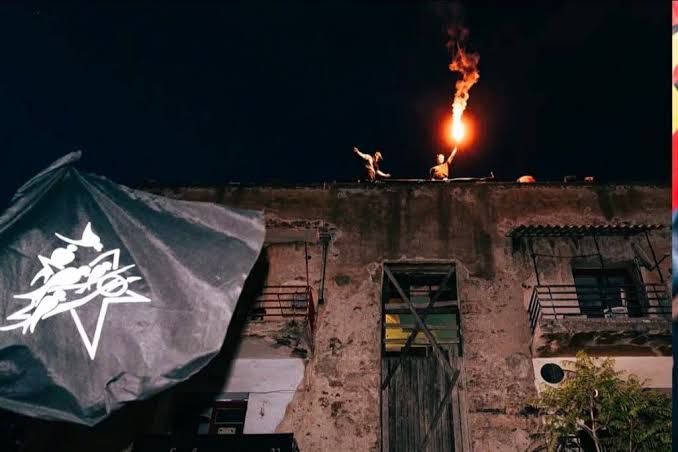
All of this is now under direct threat. In June 2025 the Region of Attica, the Ministry of Culture and the employment service (D.Y.P.A.) signed an agreement to “renovate” the first four of the eight complexes, presented as the creation of social housing. In reality it is a plan to evict the community and dismantle what exists — including the accommodation that already provides for people receiving treatment at the neighbouring cancer hospital. The community had already announced its own decision to restore the buildings with its own funds, with architects and engineers working in solidarity. The state’s “redevelopment” would drive up rents, force out residents, and destroy a vibrant social alternative in the name of the very thing — social housing — that the community already provides.
The community has decided to defend Prosfygika to the end. Two of its members and residents have put their bodies on the line in hunger strike: Aristotelis Chantzis, who began on 5 February 2026 and whose strike had at the time of our meeting passed 120 days, with vital organs beginning to fail; and Suzon Doppagne, who began on 1 May. The Greek state has responded with deception and delay, and has signalled it would ignore Amnesty International’s appeal to review the plans.
The network signed and published a statement in solidarity with the community and the hunger strikers, backing their demands in full: immediate cancellation of the contract by the Region of Attica; all residents to remain in their homes; and concrete guarantees that the restoration be carried out by the community itself, with its own funding — not a single euro of public money. The full statement is published on the INOSC website. The following day, two comrades from KIA carried the struggle further still, speaking at the demonstration against cuts and austerity — thousands strong — and reporting to the crowd on what is happening at Prosfygika.Defending Prosfygika concerns all of us. It is a matter of social justice and dignity, and of whether a self-organised community of care is allowed to exist at all.
Dehumanisation — input from KIA
The afternoon’s input was offered by comrades from KIA (the Thessaloniki Social Solidarity Clinic) under the title “Some introductory thoughts on dehumanisation” — less a lecture than a prompt for the discussion that followed. We give only a short summary here; the full text is reproduced in the meeting reader.
Dehumanisation, the input argued, is the stripping-away of the moral and emotional recognition owed to human beings — and it does not belong only to times of war. It insisted on the importance of recognising “mild dehumanisation”: the everyday process that places others outside the boundary within which our moral norms apply, a process whose carriers we ourselves may unconsciously be. Every such move rests on a “natural” process of othering and dehumanisation, informed by colonialism and capitalism.
The discussion
Several comrades insisted that dehumanisation is not a distant horror but a feature of ordinary practice. In hospitals it is routine — patients treated as illnesses rather than people, professionals who explain nothing, the loss of dignity built into the working day. “Mild” dehumanisation is keeping people waiting with no one to talk to, as in the job centre or the detention centre. Digitalisation extends it — dealing not with a person but with an automated phone line or an AI system. From this came a practical thread: accompanying someone, simply being a witness, is a way of refusing dehumanisation, because dehumanisation is easy when no one is looking. If another human being is present, at least the one being dehumanised is not alone.
A central distinction ran through the discussion: between working in solidarity and working in charity. Solidarity means autonomy, listening, respect, the recognition of the other’s agency. Charity speaks the language of pity and othering, and the moment we act from the belief that we hold the answers, we have already begun to dehumanise. Several comrades were emphatic that the work is not to hand people a solution but to discuss the problem together and help each person find their own way through it — to stay away from the doctor’s mentality of authority over the patient, and not to play gods.
The question of power was named directly. In the relationship between a clinic and the people who come to it, we hold the power, and dehumanisation lives in that structure whether we intend it or not. A clinic’s task is to be aware of that power and to work, through its democratic practices and its assemblies, against carrying the wider society’s power relations into its own space.
Some pushed on the limits of the concept. Is being short with someone when you are exhausted dehumanisation, or simply human? Several argued for the need to distinguish dehumanisation from boundaries, and from dissociation — a degree of professional distance is not in itself a denial of someone’s humanity — and for the right to fail, as humans and as activists, and to allow others the same. Others warned against the right’s framing of “civilisation in crisis,” which carries dehumanisation inside it and which we should be careful never to echo.
But the strongest current in the room placed capitalism at the root. Dehumanisation is not a symptom but a strategy: a system that pits people against each other in competition, that divides the exploited so they cannot combine. Categorisation is itself a technique of control — to dehumanise is to sort people into categories that can then be excluded, managed, or discarded as objects. Under capitalism, human beings are sorted into those who can be squeezed for profit and those to whom things can be sold; we can talk about dehumanisation all we like, but if we do not fight its greatest cause there is no fighting it at all. Comrades connected this to the police officer who beats and kills, to the coast guard that attacks refugee boats: it is not impunity alone that allows this, but a whole apparatus of techniques that train a person to become a torturer, splitting the self into the functionary who exercises violence and the citizen who goes home to an ordinary family life.
Against the apparatus, comrades set the small, concrete refusals. Reading Freire’s Pedagogy of the Oppressed against dehumanisation — am I the oppressed, or the oppressor? — one comrade argued that we do not always need to know a person’s history to make a different choice and offer back a fragment of dignity; sometimes presence itself is the intervention. The shift we make may not be visible in our own generation, may not show up as anything we can demonstrate as “impact” — and that is precisely the kind of slow, intergenerational change that the world of metrics cannot see.
FRIDAY LATE AFTERNOON
Militarisation and Healthcare
Input from the VDÄÄ
The input was given by a comrade from the VDÄÄ (the Association of German Democratic Doctors), under the title “Calculating ‘War-Readiness’: The Militarization of Healthcare between Affirmation and Resistance.” The full text is reproduced in the reader; what follows is a summary of its argument.
Since the proclamation of the Zeitenwende in 2022 and Defence Minister Pistorius’s demand that Germany be “war-ready” by 2029, the militarisation of society has reached into the healthcare system. The large-scale military exercise “Medic Quadriga 2026” rehearsed the entire “rescue chain” from the front in the Baltic region back to German hospitals — and because the Bundeswehr lacks the personnel to staff that chain, it relies on medical professionals drawn from civilian rescue and aid organisations. Under the euphemism of “civil-military cooperation,” the false impression is created that civilian and military logics are equal partners. They are not: in war, military rules and priorities apply, and the health system is required to function according to military hierarchy. Hospitals are to be made accessible to the military, to provide beds for soldiers, to train staff in war injuries, ideally to have underground facilities — requirements set out in the “Green Paper ZMZ 4.0” and to be codified in a forthcoming Health Security Act giving the Bundeswehr access to civilian healthcare workers and infrastructure.
The cruelty of the arithmetic is that all of this proceeds as though a war could be waged with limited harm because the population would be “well cared for” — while the civilian structures meant to absorb an estimated additional thousand casualties a day are already failing after decades of economic rationalisation, with hundreds more hospitals slated to close under the coming reform. Meanwhile the money flows: parliament’s open-ended rearmament fund is doing its work as a material incentive to change the “mindset,” and professional associations have learned to frame their funding demands in the language of war-readiness. The medical profession, with honourable exceptions, has met this with anticipatory obedience — organising joint symposia with the Bundeswehr, demonstrating its “defence-policy rationality.” Against this current stand the Democratic Doctors and IPPNW, who have published the brochure “We Will Not Be Able to Help You” and who insist, against the grain of their own profession, that the task of doctors is to preserve peace. The struggle, the input concluded, cannot be won on the national level alone, nor without confronting its root in the capitalist mode of production.
The discussion
The discussion brought the question home: how is militarisation already reaching into our work, and how do we respond?
The most immediate thread was the war atmosphere itself and how it reshapes healthcare from within. Comrades traced the logic of “civil-military cooperation” as it slides from disaster relief and alliance defence into something else entirely — a reordering of care around military need, in which resources are directed to keep soldiers fightable and civilians fall down the list. The reverse-triage principle was named for what it is: a hierarchy of human life value, written into planning documents, in which a wounded soldier is worth more than a sick civilian because the aim is to return him to duty. Against this, comrades held up the resistance already emerging within the profession — the refusal, by some medical bodies, to accept that doctors should sort the wounded by their military or civilian status.
A second thread connected militarisation directly to the dismantling of our health systems. The money does not appear from nowhere: it is the same logic of rationalisation and closure that has hollowed out public healthcare for decades, now rebranded as defence. Funding flows to whatever serves “war-readiness” and is withheld from ordinary care. The ongoing genocide in Palestine stands as the starkest reminder of where this logic can lead: the systematic destruction of healthcare, the killing of health workers, and the denial of medical care becoming instruments of war. Militarisation and privatisation are not two separate attacks but one.
A third thread was internationalist, and it cut against the grain of the war narrative. Comrades insisted that no one on either side actually wants this conflict — that the soldier on the front, Russian or Ukrainian, wants to be home with their family — and on the need to rebuild connections with comrades across the borders that the war is busy hardening, including in Russia and Ukraine. The struggle against militarisation, like the struggle against the economisation of healthcare, will fail if it stays inside national walls. This is precisely the work a network like ours exists to do.
Underlying all of it was a question about ourselves: the “mindset training” being prepared for healthcare workers is an attempt to remake how we think, to manufacture consent for a system in which we treat soldiers first and call it care. Naming that, and refusing it, is where resistance begins.
SATURDAY MORNING
A Manifesto for Psychosocial Support in Times of Collapse
Input from Medico International
The morning’s input came from a comrade from Medico International, presenting “Resist, Connect and Stand Up! A Manifesto for Psychosocial Support in Times of Collapse,” developed with a transnational network of more than thirty people from twelve organisations across four continents. The full Manifesto is reproduced in the reader; we summarise its argument here.
The Manifesto is an objection to the abuse of psychological approaches to obscure oppression, and a call to reclaim the political and emancipatory core of psychosocial work. Its diagnosis is sharp. The dominant frameworks of trauma and resilience, however useful they once were, have been used and abused to the point of emptiness: trauma has been stretched across so many different experiences that it has lost its meaning in the context of political and social violence, individualising and pathologising what are in fact collective wounds; resilience has been captured by neoliberal ideology, turned into a demand that the marginalised “strengthen” themselves to survive the unsurvivable rather than a reason to defend collective protection. Psychosocial programmes are too often used as a token substitute for justice, reparation and redistribution. And care itself is systematically exploited — more and more is demanded of psychosocial workers while support and protection are stripped away, with “self-care” reframed as the individual’s responsibility to cope.
Against this, the Manifesto sets a different understanding: that the impacts of violence are sociopolitical, that “mental health crises” are often normal reactions to abnormal conditions, and that we must work not only on symptoms but on root causes. It calls for psychosocial work to be openly political — scrutinising health policy, intervening in legal and policy spaces, naming injustice. It insists that those who give care are themselves “wounded carers,” not heroes and not experts standing outside the system, and that collective care must replace the optimisation of individual coping. And it calls for transnational organising: “What affects you should affect me.” Global shifts need global voices.
The discussion
The discussion took up the Manifesto’s hardest challenge: how to act on this analysis in the actual conditions of our work, where people arrive in real and immediate need.
Several comrades pressed the practical difficulty. Our diagnoses mirror the neoliberal age, individualising social problems — but in an individual forty-minute session, with someone who needs a job or decent housing now, what can we actually do? The reply was not to abandon individual work but to refuse to stop there: interprofessional teams, and the bringing-together of people who share a condition — those facing the same housing struggle, for instance — so that what is lived as private failure can be recognised as common. But one comrade named the limit with a force the room felt: political interventions and attempts to collectivise the struggle, through workshops or by organising demonstrations, are vital — and yet when the workshop ends and the demonstration disperses, people go back to the same exploitative job, the same overcrowded and precarious housing, the same conditions that made them ill. Also taking part in political action can be more exhausting than liberating, especially for who is exposed to daily structural violence.
A second thread questioned who “we” and “they” are. Comrades from Medico warned against projecting our own activist fantasies of resistance onto the people we support, and against the heroism the Manifesto rejects. The point is not that we stand outside, untouched, helping the wounded — we live inside the same conditions, wounded ourselves. The transnational network was described honestly: not a success story, but a group of people who have come to trust one another.
A third thread pushed at the boundaries of psychosocial work itself. Comrades raised the question of support not only after conflict but during it — for people in ongoing struggle and resistance, not only in the aftermath. The example of Afghan women was discussed: the German government poured money into individual counselling, which was needed, but what was missing was the building of the collective and social structures that might have formed an infrastructure for resisting the return of the Taliban. Diagnosis, several insisted, is something that stops you thinking about the person; the categories were largely made by white men and take no account of cultural context. Sometimes, where there are no resources and no infrastructure, presence itself is the intervention — though comrades were honest that presence can also become a form of imposition, even when we do not mean it to be.
What held the discussion together was the Manifesto’s refusal to separate care from struggle. If health is not just the absence of sickness but the whole of life, then it is bound up with every struggle there is — and the task is to keep moving, constantly, between the structural and the personal, caring for people and changing the system at once, because neither is enough on its own.
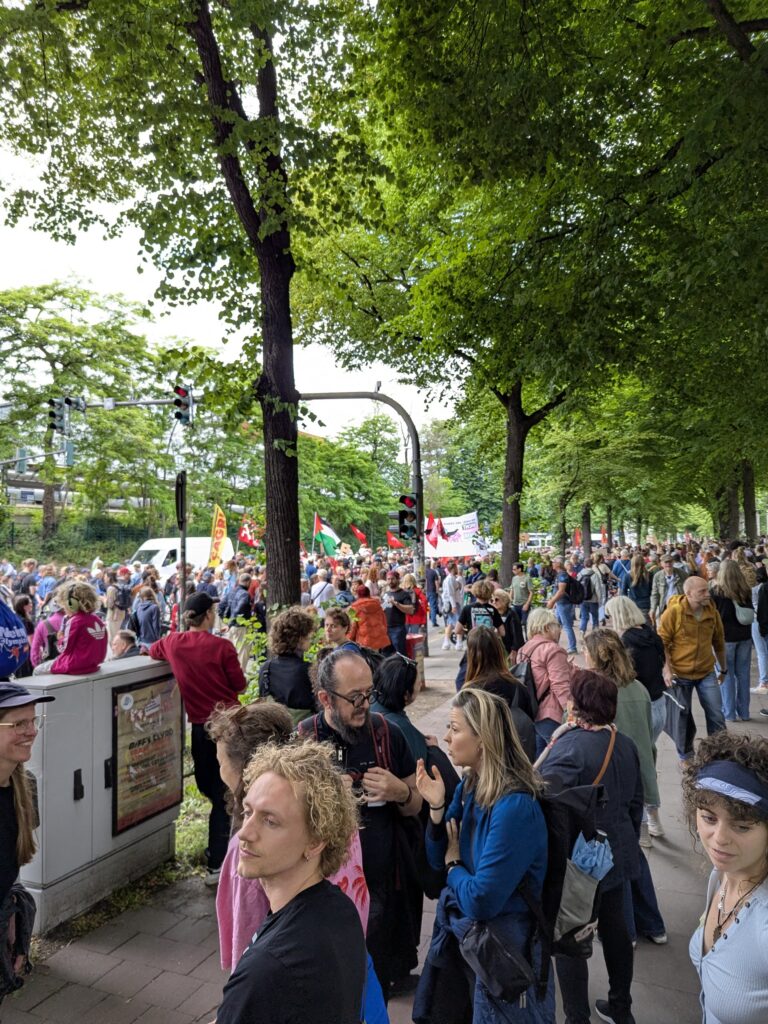
Following the morning, we joined the demonstration against cuts and austerity in the city, where comrades from KIA spoke and carried the struggle of Prosfygika to the crowd and comrades from Poliklinik Veddel highlighted the struggles in guaranteeing basic human rights. It was a fitting answer to the morning’s question: care that does not stop at the clinic door, but takes to the street, protesting for the wellbeing of all oppressed collective subjectivities.
SATURDAY
Mutualism and Financing
Input from Medicine Pour le Peuple
The afternoon’s input came from comrades from Medicine Pour le Peuple (Geneeskunde voor het Volk), the network of workers’ health centres in Belgium tied to the Workers’ Party (PTB).
Medicine Pour le Peuple runs 11 health centres, with around 250 workers and 27,000 patients. Its origins lie in the doctors’ strike of 1971, and the slogan that came out of it still defines the project: not doctors for the money, but doctors for the people. These are not only health centres but action centres for the right to health, and many of those who work in them are also organisers in the party. There is no hierarchy between receptionists, family doctors and administrators; each centre has two leaders, one practical and one political, and the whole network is run on the basis of democratic centralism — decisions taken centrally, with each centre deciding how to implement them. “We are red and experts,” comrades said: people who have studied, and whose task is to democratise that knowledge rather than hoard it.
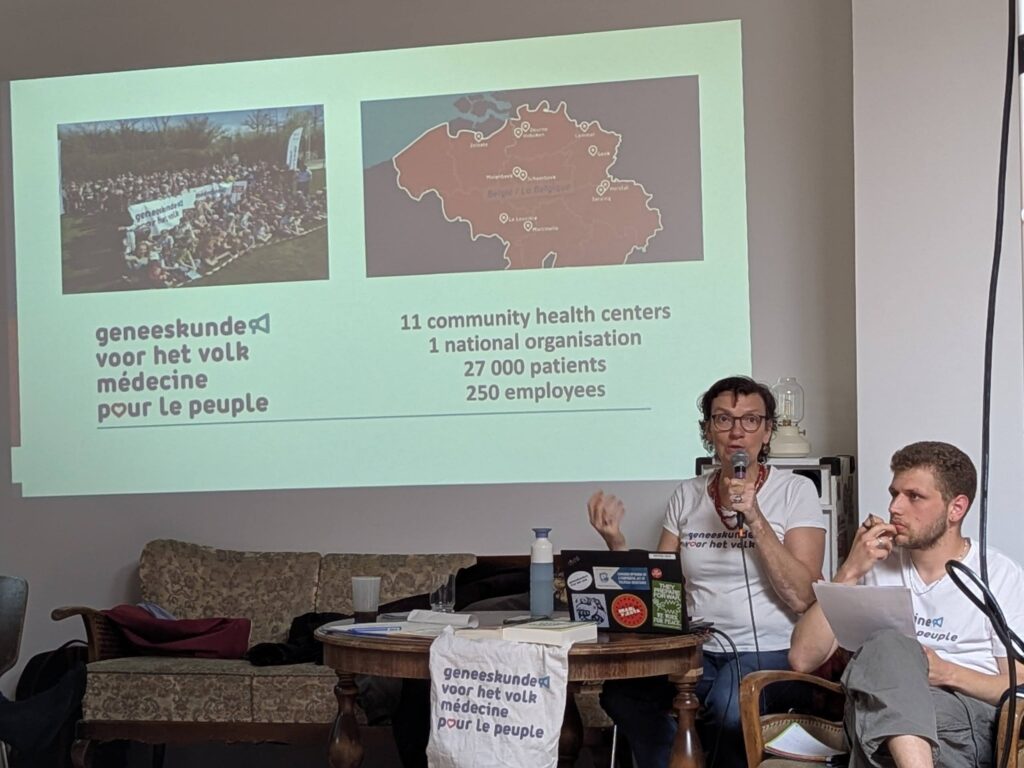
On financing, the comrades explained the Belgian system clearly. Primary care can be funded in two ways: fee-for-service, or the lump-sum forfait — a capitation payment, a fixed sum per registered patient regardless of how many times they come. Medicine Pour le Peuple works on the forfait, which means they are paid to care for a population rather than paid per act, and are not pushed to justify each individual intervention. They were candid that the model can be placed under pressure and viewed with suspicion by authorities, and that there are growing attempts to limit the number of patients they take on.
Beyond the funding mechanism, the heart of the input was empowerment, resting on three pillars: critical awareness, control, and action. Care here means involving patients in their own treatment and thinking together about the social context of illness — working conditions, housing, the shape of a life — so that people understand they are not alone in it. They took up a union request to win recognition of occupational disease for cleaners and domestic workers, the medical expertise and the legal expertise advancing together. When the centres moved premises, patients took part in the rebuilding. All of this removes the doctor from the pedestal society places them on: they are, in the end, just human beings. The “social stethoscope” was the image offered — listening to the problems people bring, and transmitting them upward to the party’s people in parliament: street, council, street, beginning and ending in the neighbourhoods where the centres work.
The association with the PTB is a conscious choice. Neutrality in the consultation is necessary — everyone is treated — but neutrality in the social struggle, they argued, is already taking a side. For this reasong they also take part in broader campaigns, supporting the people who are resisting the genocide in Palestine and the cuban comrades which are under attack from the USA’s embargo.
The discussion: how we sustain ourselves, and at what cost
The input opened directly onto the question that has run through every one of our meetings — how do we finance ourselves, and what does the answer do to us? That this was still a live question at the fifth gathering was itself remarked upon: why do we keep needing to specify how we take money and how we do not, and why does it stay open? The answer is that there is always a degree of real disagreement among us, and that we are many realities spread along a continuum of different choices that nonetheless share a common political reading. The session laid that continuum out honestly.
At one pole stands KIA, whose position was the sharpest. The goal of the clinic is not to offer care to as many people as possible; it is political intervention and social initiative. KIA offers what it can, and takes funding only from social initiatives, individuals and trade unions — never from political parties or from the institutions responsible for austerity and the dismantling of the health system. Providing services is not the crucial part; raising consciousness and building struggle for the right to health is. This is, above all, what guarantees autonomy and independence, and what keeps creative thought and desire possible.
Others described the compromises they have made with eyes open. Comrades from Bologna (LSP) distinguished between how a clinic takes money and how the network does — the latter being a political question for all of us. In Bologna the work is volunteer-based, but they found a way to draw European funding for psychotherapy they could not otherwise afford, because their psychologists could not hold together clinic work and the paid work that sustains them. Comrades from Leipzig framed it differently again: the state is responsible for the policies that destroy the health system, and what they refuse is to provide free services on the state’s behalf. They take rent from local authorities and keep autonomy over contracts and hours — including hours set aside specifically for political work. “We can trick the state only in small ways.”
If KIA grounds autonomy in the refusal of money, others made the opposite case: that being paid is itself a form of freedom. From within a network sustaining around a hundred paid positions, one comrade argued that salaried work produces an enormous amount of what the struggle needs, and that not every clinic has to tackle every issue in the most radical way, because the radical messages can travel through the wider web of associations we are connected to. To recognise the work through money, another put it, is itself a political act. This is not the same as dependence: Medicine Pour le Peuple, salaried through the forfait, were clear that they are prepared for the government to cut their funding, and treat the structure that pays them accordingly.
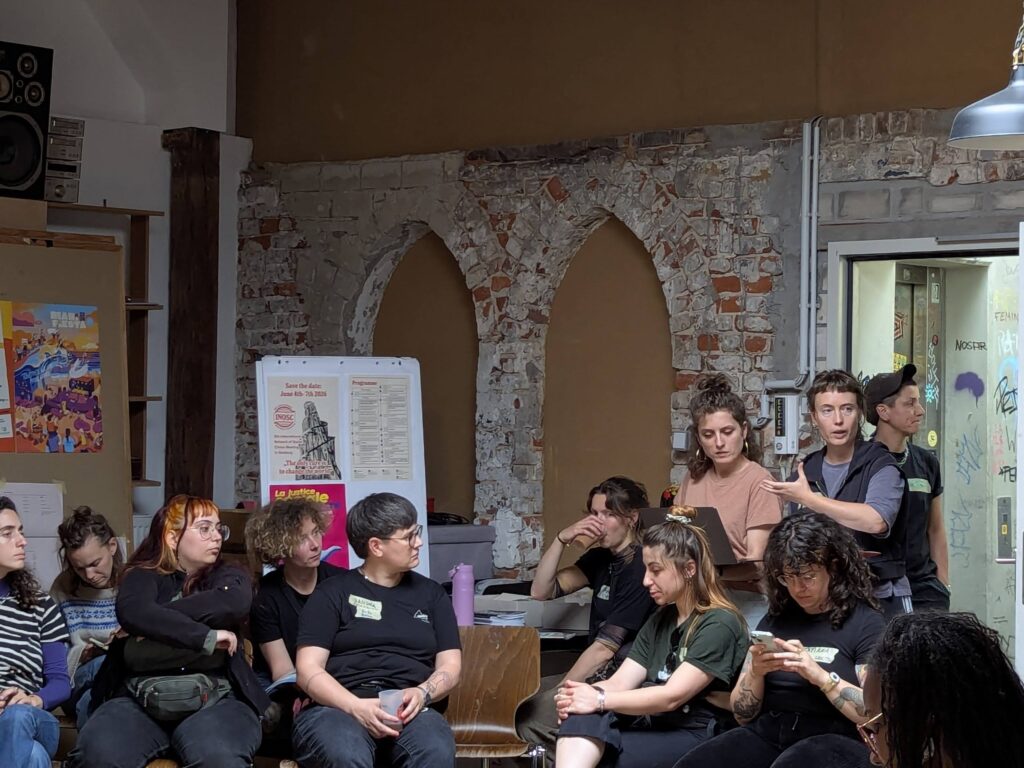
One comrade pressed everyone hard on strategy and honesty: we know each other well enough to be critical, and we cannot call ourselves a success story. In a capitalist system, private healthcare is still often better resourced; we have organised for undocumented people for over twenty years and, in the round, little has changed — someone may get a hip replacement, but what is transformed? We would need to be more honest about that. The answers to this did not pretend to a master plan. Some were explicit that they are not trying to take over the system but to provide a living example of how things can be done differently, with decisions taken by the people who use the clinic. Others insisted that we cannot strategise alone — that how we transform society is a movement-wide question, requiring both persistent syndicalist demands and connection to the rest of the movement.
The most powerful answer came from a Greek comrade, and it reframed the whole debate. We are people who work for free because we want to respond actively to what is being done to us; if we wanted to be passive, we could stay home. It is not about winning or losing — it is about remaining active. To organise without hierarchy and without funding is a political decision, and one made among comrades, not volunteers. And it carries a warning written in recent history: a decade ago there were forty-odd social clinics in Greece, and many of them ceased to exist when SYRIZA came to government and extended national health insurance to the uninsured — their members judging that their work was no longer needed. That cycle of struggle should stay in our minds. Whatever choice each of us makes about money, we must remember that we are acting within a capitalist system and we have to prepare for what happens when the funding, or the political conditions, are taken away — and treat any structure that funds us as a worker treats the boss: as a relation of struggle, never of dependence.
It was left, fittingly, as a tension rather than a resolution: freedom against restriction, salary against constraint, longevity, and the need for honesty and comradely self-criticism among us. The session closed by looking outward — toward finding other groups, other realities building another way of living within capitalism, different from our own, to learn from and connect with.

SUNDAY
The Veddel and the Harbour
The final day took us out of the meeting hall and into the city that had hosted us — to read health through the streets, the water and the social forces that shape both.
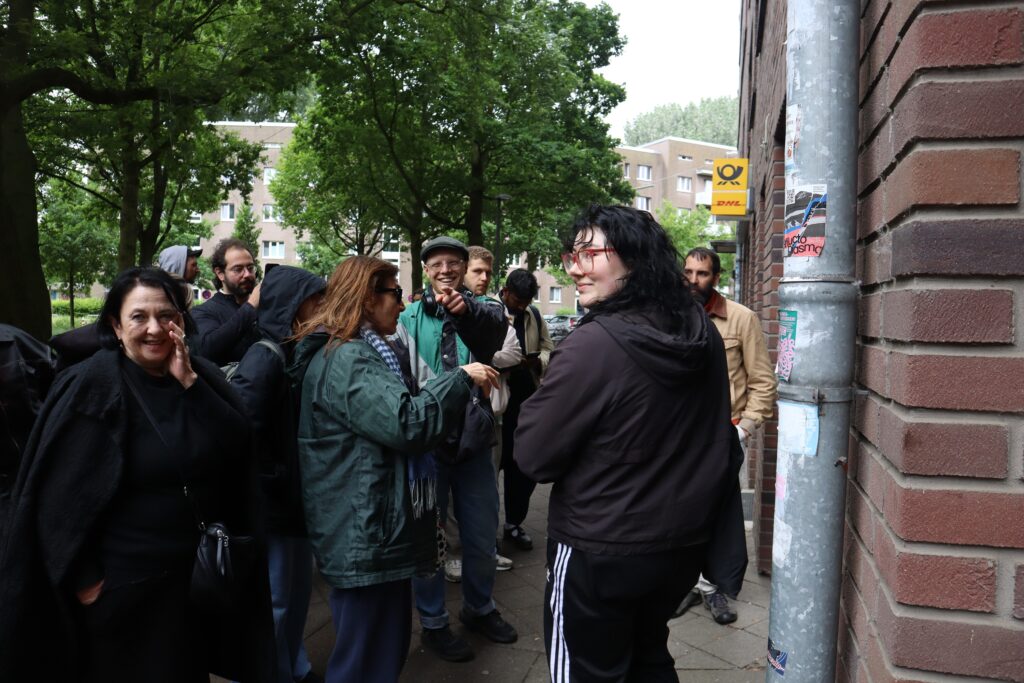
The morning was a tour of the Veddel, the working-class, migrant district on an island in Hamburg’s harbour where the Poliklinik has its home. We walked through the neighbourhood with the comrades who work there, seeing how a community health centre embeds itself in the everyday life of a place long shaped by industry, migration, poor housing and the social determinants of health — and how it tries to be a base for the neighbourhood rather than a service delivered to it.
The afternoon took us onto the water, for a tour of the port of Hamburg organised around the theme of health — run together with comrades who have been making political harbour tours for decades. From the boat we read the harbour as a map of the historical and political forces that shaped health: the cholera epidemics that scarred the city’s history; food and its production; sex work; labour and working conditions; and the global trade routes and multinationals whose goods and profits move through the port. Health, seen this way, is inseparable from the circuits of imperialism and capital that decide, far upstream and long before any social clinic, who will stay well and who will not.
And then — onwards. To our social clinics, to our neighbourhoods, to the struggles we returned to, and to the next time the network gathers.
The only cure is to change the world.